
Table of contents
- Vapor Intrusion Explained
- What Is Vapor Intrusion?
- Where Do Vapor Intrusion Risks Come From?
- How Do Contaminated Vapors Enter a Building?
- What Are the Potential Health Concerns?
- Signs That a Property May Require Further Evaluation
- How Is Vapor Intrusion Investigated?
- What Is a Sub-Slab Depressurization System?
- Why Vapor Intrusion Matters During Construction and Redevelopment
- Excavation and Vapor Intrusion: Why Construction Planning Matters
- Vapor Intrusion and Brownfield Redevelopment
- How Can Vapor Intrusion Risks Be Reduced?
- What Property Owners Should Do If Vapor Intrusion Is Suspected
- Vapor Intrusion in Massachusetts
- Frequently Asked Questions About Vapor Intrusion
- Summary

Vapor Intrusion Explained
Vapor intrusion is an environmental concern that can occur when chemical vapors from contaminated soil or groundwater migrate into buildings through cracks, joints, utility penetrations, or other pathways in a foundation or slab. While the contamination may be below ground and out of sight, certain volatile chemicals can move through soil as vapor and potentially enter occupied spaces.
For homeowners, commercial property owners, developers, and contractors in Massachusetts and throughout New England, understanding vapor intrusion is an important part of evaluating environmental conditions before construction, renovation, redevelopment, or changes in building use.
Vapor intrusion does not automatically mean that a building is unsafe. The potential risk depends on the contaminants present, their concentrations, the pathway between the contamination and the building, building conditions, and the results of appropriate environmental testing.
What Is Vapor Intrusion?
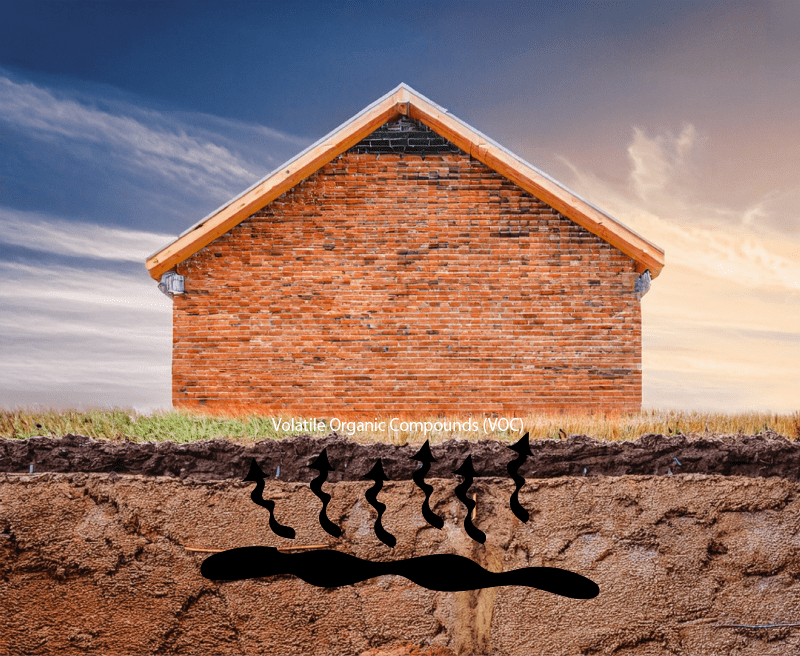
Vapor intrusion occurs when volatile contaminants in soil or groundwater migrate upward as vapor and enter a building.
Some chemicals can readily transition from a dissolved or residual form into a vapor. When these compounds are present beneath or near a building, vapors may migrate through the subsurface and follow pathways into the structure.
Common entry points can include:
- Cracks in concrete slabs
- Foundation wall cracks
- Construction joints
- Floor drains
- Sumps and pits
- Utility penetrations
- Pipe chases
- Gaps around plumbing or electrical conduits
- Unsealed openings in foundations
- Crawl spaces and dirt floors
Once vapors enter an enclosed structure, they can accumulate depending on factors such as ventilation, building construction, pressure differences, and the characteristics of the contaminant.
This is why vapor intrusion is evaluated as a source-pathway-receptor issue: there must be a contaminant source, a viable pathway for migration, and a potential receptor such as occupants inside a building.
Where Do Vapor Intrusion Risks Come From?

Vapor intrusion is generally associated with volatile contaminants in soil or groundwater (VOCs). These contaminants can originate from a variety of historical or current activities.
Potential sources may include:
- Former industrial properties
- Dry-cleaning operations
- Manufacturing facilities
- Automotive and service businesses
- Fuel storage areas
- Petroleum releases
- Solvent releases
- Leaking underground storage tanks
- Former commercial or industrial operations
- Properties affected by historical spills or releases
In Massachusetts, environmental conditions may also be associated with properties subject to the Massachusetts Contingency Plan (MCP) and other environmental requirements.
A property’s current appearance does not necessarily indicate whether environmental concerns exist. A parcel that appears suitable for redevelopment may still have historical contamination that requires investigation.
How Do Contaminated Vapors Enter a Building?
Vapor migration through the subsurface can be complex.
Contaminants may be present in soil or groundwater beneath a building, while the building itself provides multiple potential pathways for vapor movement. Vapors can move through porous soils and then enter the structure through openings or imperfections in the foundation system.
One important factor is the pressure relationship between the building and the surrounding soil.
If indoor air pressure is lower than the pressure in the subsurface, the building can effectively draw soil gas toward it. This can increase the potential for vapors to enter through cracks, joints, penetrations, or other openings.
Building conditions can therefore influence vapor intrusion even when the contamination itself has not changed.
What Are the Potential Health Concerns?
The potential health implications of vapor intrusion depend on the specific contaminant, concentration, duration of exposure, and other site-specific conditions.
Some volatile organic compounds (VOCs) can pose health concerns when people are exposed to elevated concentrations over certain periods of time.
However, it is important not to assume that the presence of a chemical automatically means that occupants are being exposed at a dangerous level.
Environmental professionals evaluate the actual conditions at a property, including contaminant concentrations and potential exposure pathways, to determine whether mitigation or additional investigation is appropriate.
Because health-risk determinations can be highly site-specific, property owners should rely on qualified environmental professionals and applicable regulatory guidance rather than attempting to determine risk based solely on the presence or absence of visible contamination.

Signs That a Property May Require Further Evaluation

Vapor intrusion is not something that can reliably be identified through a visual inspection alone.
A property may warrant environmental evaluation when there is:
- Known soil or groundwater contamination
- A history of industrial or commercial use
- A former dry-cleaning or manufacturing operation
- A known petroleum or solvent release
- Environmental investigation documentation
- A brownfield redevelopment project
- Contaminated groundwater beneath or near a structure
- Historical environmental restrictions or regulatory activity
- Proposed construction over an area of known or suspected contamination
For redevelopment projects, environmental due diligence can be particularly important before excavation or construction begins.
How Is Vapor Intrusion Investigated?
Environmental professionals may use several types of sampling and investigation techniques depending on site conditions.
The investigation may include review of historical property information, environmental records, previous sampling results, and site conditions.
Field investigations can potentially include:
- Soil sampling
- Groundwater sampling
- Soil-gas sampling
- Sub-slab vapor sampling
- Indoor air sampling
- Ambient air sampling
- Foundation and slab evaluations
- Utility and subsurface pathway assessments
The appropriate sampling approach depends on the property and the contaminants being evaluated.
Sub-slab sampling, for example, can provide information about vapor concentrations directly beneath a building slab. Indoor-air sampling may be used to evaluate conditions within occupied spaces.
The goal is to determine whether a complete or potentially complete vapor intrusion pathway exists and whether additional investigation or mitigation is warranted.

What Is a Sub-Slab Depressurization System?

You can read more about Sub Slab Depressurization Systems in our resource guide:
One common engineering approach to addressing vapor intrusion is a sub-slab depressurization system (SSDS).
An SSDS is designed to collect soil gas from beneath a building slab and direct it away from the occupied space before it can enter the building.
Depending on the structure and site conditions, a system may incorporate:
- Extraction points beneath the slab
- Collection piping
- A mechanical fan
- Ventilation piping
- Monitoring components
- Sealing of certain potential entry points
An SSDS does not eliminate the contamination source. Instead, it is a mitigation measure designed to control the vapor pathway and reduce the potential for vapors to enter the building.
The appropriate system design should be based on site-specific environmental conditions and applicable regulatory requirements.
Why Vapor Intrusion Matters During Construction and Redevelopment
Vapor intrusion should be considered before construction begins when environmental concerns are known or suspected.
Excavation, foundation construction, utility installation, slab replacement, and building renovations can change subsurface conditions and potentially affect existing vapor pathways.
For developers and contractors, environmental conditions should be evaluated as part of project planning rather than discovered after construction has already started.
Early coordination between the property owner, environmental consultant, engineer, contractor, and applicable regulatory authorities can help identify environmental requirements before they affect the construction schedule.
This is particularly important for brownfield redevelopment and properties with historical industrial or commercial uses.

Excavation and Vapor Intrusion: Why Construction Planning Matters

Excavation activities can encounter contaminated soil or groundwater that was not obvious from surface conditions.
When environmental contamination is known or suspected, excavation planning may need to account for:
- Soil characterization
- Material handling
- Temporary stockpiling requirements
- Soil disposal or reuse requirements
- Worker protection
- Dust and vapor controls
- Groundwater management
- Utility installation
- Foundation construction
- Regulatory requirements
- Documentation and reporting
Contractors working on environmentally impacted properties should understand the project’s environmental controls before excavation begins.
Environmental remediation and construction are often closely connected. The excavation contractor may be responsible for performing the physical work, while environmental professionals establish sampling, characterization, regulatory, and remediation requirements.
Clear communication between those parties is essential.
Vapor Intrusion and Brownfield Redevelopment
Brownfield properties can present unique environmental challenges because previous industrial or commercial activities may have left contaminants in soil or groundwater.
Vapor intrusion can become an important consideration when an existing building remains on the property or when redevelopment involves new foundations, slabs, utilities, or enclosed structures.
Environmental assessment before redevelopment can help identify potential concerns early in the project.
Depending on the property, the solution may involve additional investigation, removal of contaminated material, engineering controls, institutional controls, vapor mitigation, or a combination of approaches.
There is no single remediation strategy that applies to every site.
How Can Vapor Intrusion Risks Be Reduced?
The appropriate response depends on the site investigation and the contaminants involved.
Potential strategies can include:
- Additional environmental investigation
More sampling may be necessary to understand contaminant distribution and determine whether a vapor pathway exists. - Source removal or remediation
Removing or treating contaminated soil or addressing groundwater contamination may reduce the source of vapors. - Pathway controls
Cracks, penetrations, joints, and other potential entry points may be sealed where appropriate. - Sub-slab depressurization
An engineered system can collect and vent soil gas from beneath a building. - Building ventilation or other engineering controls
Site-specific engineering measures may sometimes be appropriate. - Long-term monitoring
Some properties require continued monitoring to verify that environmental conditions remain within applicable requirements.
The correct approach should be determined through site-specific environmental evaluation rather than selecting a mitigation system based solely on the property’s history.
What Property Owners Should Do If Vapor Intrusion Is Suspected
If you suspect that a property may have a vapor intrusion concern, avoid relying on odor or visual observations as an indication of whether a problem exists.
Instead, consider obtaining an environmental assessment from a qualified professional.
Useful information can include:
- Historical property uses
- Previous environmental reports
- Known releases
- Soil and groundwater sampling data
- Existing regulatory records
- Building construction information
- Foundation and slab conditions
- Previous vapor or indoor-air sampling
- Proposed future construction plans
If construction is planned, bring the environmental consultant and construction team into the planning process early.
Early identification can help prevent environmental requirements from becoming an unexpected construction issue.

Vapor Intrusion in Massachusetts
Massachusetts properties can be subject to specific environmental investigation and remediation requirements depending on the nature and extent of contamination.
The Massachusetts Department of Environmental Protection (MassDEP) regulates releases of oil and hazardous materials through the Massachusetts Contingency Plan and related environmental programs.
For a property with known or suspected contamination, environmental professionals can help determine the applicable regulatory pathway and whether additional investigation or response actions are necessary.
Construction contractors should not independently interpret environmental regulations or make health-risk determinations. Their role is to work within the project’s environmental plan and coordinate construction activities with the appropriate environmental and engineering profession
Frequently Asked Questions About Vapor Intrusion
No. Contaminated soil is a potential source of vapor intrusion, but vapor intrusion specifically concerns the migration of volatile contaminants through the subsurface and their potential entry into a building.
Yes. Vapor intrusion can be associated with contaminants in groundwater or other subsurface sources. The specific site conditions determine whether vapors can migrate toward and into a structure.
Not necessarily. Some contaminants have recognizable odors, but odor is not a reliable method for determining whether vapor intrusion is occurring or whether exposure levels are safe.
Not automatically. The appropriate response depends on the contaminant, concentration, exposure pathway, building conditions, and results of environmental evaluation. Site-specific decisions should be made by qualified environmental and health professionals.
In many cases, the potential pathway can be mitigated or controlled. Depending on the site, solutions may include source remediation, sealing, sub-slab depressurization, or other engineering controls.
No. A sub-slab depressurization system is generally a vapor mitigation measure. It controls the pathway beneath the building but does not by itself remove the underlying contamination source.
Summary
Vapor intrusion is an environmental issue that can be easy to overlook because the contamination responsible for the vapors may be located beneath the building or property.
Understanding the relationship between contaminant source, vapor migration, building pathways, and potential exposure is essential when evaluating properties with known or suspected environmental contamination.
For property owners and developers, the best time to address potential vapor intrusion concerns is before construction or redevelopment begins. Environmental investigation, regulatory planning, engineering controls, and construction planning should work together to protect the project and avoid unnecessary delays.
For contractors, understanding vapor intrusion is equally important. Excavation, foundation construction, utility installation, and slab work can all intersect with environmental conditions below the surface.
When environmental concerns are identified early, the project team can develop a coordinated approach that addresses remediation and construction requirements together.
Construction Solutions, Inc. provides excavation, site work, environmental remediation support, and subsurface construction services throughout Massachusetts, Southern New Hampshire, and Southern Maine.
For projects involving contaminated soil, environmental conditions, vapor mitigation systems, or redevelopment of environmentally impacted properties, early coordination with the appropriate environmental professionals and construction team can help establish a safer and more predictable path forward.