
Table of contents
- Phase II Environmental Site Assessment
- What Is a Phase II Environmental Site Assessment?
- When Is a Phase II Environmental Site Assessment Needed?
- Phase I vs. Phase II Environmental Site Assessment
- What Does a Phase II Environmental Site Assessment Involve?
- The Role of Test Pits and Soil Sampling
- What About Groundwater Sampling?
- Who Performs a Phase II Environmental Site Assessment?
- What Happens If Contamination Is Found?
- When Does Environmental Remediation Become Necessary?
- Why Early Planning Matters
- Phase II ESA and Massachusetts Environmental Projects
- Choosing the Right Contractor for Environmental Investigation Support
- From Environmental Investigation to Remediation

Phase II Environmental Site Assessment
When a Phase I Environmental Site Assessment identifies a potential environmental concern, the next step may be a Phase II Environmental Site Assessment (ESA).
Unlike a Phase I ESA, which primarily evaluates historical records, current property conditions, and other available information to determine whether potential environmental concerns exist, a Phase II ESA involves physical investigation and sampling to determine whether those concerns are actually present.
For property owners, developers, investors, and commercial buyers, understanding when a Phase II may be appropriate—and what the investigation can involve—is an important part of environmental due diligence.
What Is a Phase II Environmental Site Assessment?
A Phase II Environmental Site Assessment is a targeted environmental investigation used to evaluate potential contamination or other environmental concerns identified during a Phase I ESA or through other property-specific information.
The investigation may involve collecting samples from soil, groundwater, soil vapor, or other environmental media and submitting those samples for laboratory analysis.
The exact scope depends on the suspected source, contaminants of concern, site history, geology, property use, and the findings that led to the investigation.
A Phase II is therefore not a standardized test performed the same way on every property. The investigation should be designed around the specific environmental concerns associated with the site.

When Is a Phase II Environmental Site Assessment Needed?

A Phase II ESA may be recommended when a Phase I identifies a Recognized Environmental Condition (REC) or another concern that requires additional investigation.
Examples can include historical or current property uses associated with petroleum products, hazardous substances, industrial operations, waste handling, underground storage tanks, or other potential sources of contamination.
A Phase II may also be considered when available information does not adequately resolve an environmental concern.
For example, a property may have a history of commercial or industrial use, but available records may not establish whether a former release occurred or whether contamination remains in the subsurface.
Additional investigation can help determine whether the concern identified during due diligence represents an actual environmental condition.
Phase I vs. Phase II Environmental Site Assessment
The simplest way to understand the distinction is:
Phase I:
Evaluates available information and property conditions to identify potential environmental concerns.
Phase II:
Uses field investigation and laboratory analysis to evaluate whether environmental contamination or another suspected condition is actually present.
A Phase I generally does not involve collecting environmental samples. A Phase II may involve intrusive investigation, sampling, laboratory testing, and other field activities depending on the objectives of the investigation.
This distinction is important because a Phase I does not necessarily confirm that contamination exists. It identifies conditions that may warrant further evaluation.

What Does a Phase II Environmental Site Assessment Involve?
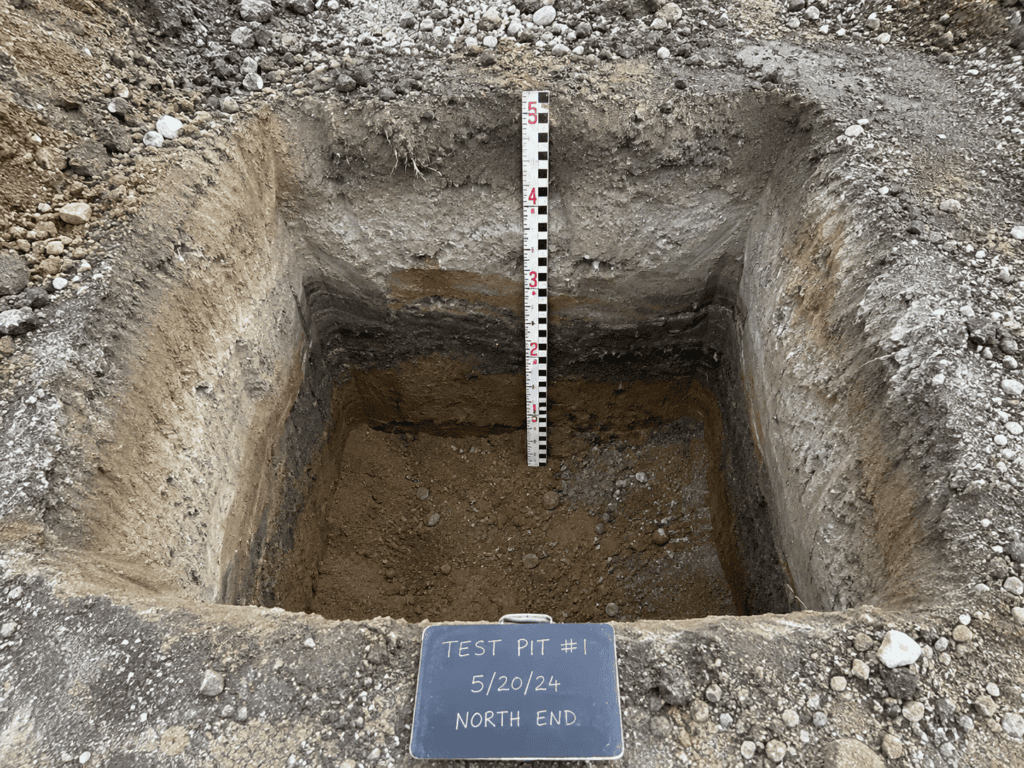
The scope of a Phase II investigation varies significantly from property to property.
Depending on the suspected environmental concern, investigation activities may include:
- Soil borings
- Test pits
- Soil sampling
- Groundwater sampling
- Monitoring wells
- Soil vapor sampling
- Field screening
- Laboratory analysis
- Subsurface investigation
- Investigation around former tanks or other potential release areas
The investigation is generally designed to answer specific questions about the property.
For example:
Is contamination present?
Where is it located?
What contaminants are present?
How far does the contamination extend?
Is groundwater affected?
Does the contamination pose a potential risk to the property or surrounding environment?
The answers can help environmental professionals determine what additional investigation or corrective action may be appropriate.
The Role of Test Pits and Soil Sampling
Test pits can be useful when an investigation requires direct observation or sampling of shallow subsurface materials.
Depending on site conditions and the investigation objectives, test pits may help identify soil characteristics, buried materials, fill, debris, staining, or other conditions that warrant further evaluation.
Soil sampling can provide laboratory data regarding the presence and concentration of specific contaminants.
Sampling locations and depths should be selected based on the environmental investigation’s objectives rather than simply collecting samples at random locations.
This is one reason coordination between the environmental professional directing the investigation and the excavation contractor performing field work is important.

What About Groundwater Sampling?

Groundwater investigation may be appropriate when there is a potential pathway for contamination to reach groundwater or when available information indicates that groundwater could be affected.
Depending on the site and investigation objectives, this can involve monitoring wells and groundwater sampling followed by laboratory analysis.
Groundwater conditions can be particularly important because contamination may migrate beyond the original source area.
Understanding the direction and extent of potential groundwater impacts can therefore be an important component of environmental site investigation and subsequent remediation planning.
Who Performs a Phase II Environmental Site Assessment?
A Phase II ESA should be designed and interpreted by an appropriately qualified environmental professional.
The environmental professional determines the objectives of the investigation, identifies appropriate sampling locations and methods, evaluates laboratory results, and determines what the findings mean in the context of the property.
Contractors can play an important role in the field portion of the work.
Depending on the investigation, a qualified excavation or vacuum excavation contractor may be needed to safely expose subsurface conditions, excavate test pits, daylight utilities, access difficult areas, or support environmental sampling activities.
This is particularly important on developed properties where underground utilities, existing structures, pavement, limited access, or other site constraints can complicate subsurface investigation.
What Happens If Contamination Is Found?
A Phase II does not automatically mean that a property cannot be developed or purchased.
Instead, the results provide additional information that can help the property owner, developer, environmental professional, lender, or other stakeholders understand the environmental condition of the site.
If contamination is identified, additional steps may include:
- Defining the extent of contamination.
- Conducting additional sampling or investigation.
- Evaluating potential exposure pathways.
- Developing a remediation or response strategy.
- Excavating and properly managing contaminated soil when appropriate.
- Coordinating transportation and disposal or treatment.
- Performing confirmation sampling.
- Completing applicable regulatory requirements.
The appropriate response depends on the contaminant, concentration, location, affected media, property use, regulatory requirements, and other site-specific factors.
When Does Environmental Remediation Become Necessary?
Not every Phase II investigation results in remediation.
Sometimes laboratory results show that a suspected concern is not present. In other cases, additional investigation may be necessary before the extent or significance of a condition can be determined.
When contamination is confirmed and corrective action is required, environmental remediation may become the next stage of the project.
Remediation can involve activities such as contaminated soil excavation, material segregation and management, environmental sampling support, site restoration, and coordination with the environmental professional overseeing the project.
At this stage, excavation and site work must be performed carefully because the work is no longer simply conventional earthwork. The contractor may be working with impacted materials, restricted work areas, utilities, structures, groundwater, or other environmental and safety considerations.

Why Early Planning Matters
Environmental investigations can have a significant effect on a development project’s schedule and budget.
Discovering an environmental issue after construction has already begun can create unexpected delays, additional excavation, disposal costs, permitting requirements, and changes to the original site plan.
Addressing environmental concerns during due diligence can give property owners and developers more information before major construction decisions are made.
For commercial property acquisitions and redevelopment projects, integrating environmental due diligence with site planning and construction planning can help reduce surprises later in the project.
Phase II ESA and Massachusetts Environmental Projects
Environmental investigation and remediation projects in Massachusetts can involve state-specific requirements and coordination with environmental professionals, laboratories, contractors, disposal facilities, and regulatory agencies.
Projects involving contaminated soil or other environmental concerns may require careful planning for excavation, characterization, transportation, disposal, documentation, and site restoration.
Because the regulatory pathway depends on the specific environmental condition and project circumstances, property owners and developers should work with qualified environmental professionals to determine the appropriate course of action.
Contractors supporting the field work should understand their role within that larger process and coordinate closely with the environmental team.

Choosing the Right Contractor for Environmental Investigation Support

Environmental investigation work often requires a different approach from conventional excavation.
The contractor may need to work around existing utilities, structures, pavement, restricted-access areas, or sensitive portions of a property while maintaining the integrity of the investigation.
Depending on the project, vacuum excavation can also provide a useful method for exposing subsurface utilities or investigating specific areas while reducing the risk associated with conventional mechanical excavation.
Experience with environmental projects, careful material handling, communication with the project environmental professional, and attention to site conditions are all important considerations when selecting a contractor.
From Environmental Investigation to Remediation
A Phase II Environmental Site Assessment can provide critical information about what is actually occurring beneath a property.
The investigation may confirm that a suspected concern is not present, identify a localized condition, or reveal contamination that requires additional investigation and potentially remediation.
Understanding this process allows property owners and developers to make better-informed decisions before moving forward with major construction or redevelopment work.
For projects requiring test pits, environmental excavation, soil sampling support, contaminated soil removal, vacuum excavation, or other environmental site work, coordination between the environmental professional and experienced field contractor is essential.
Construction Solutions, Inc. supports environmental and excavation projects throughout Massachusetts, Southern New Hampshire, and Southern Maine, working with property owners, developers, contractors, and environmental professionals on complex site and subsurface work.
If a Phase I ESA has identified a potential environmental concern on your property, the next step is to determine what additional investigation may be appropriate, and how that investigation can be safely and efficiently performed.