

Dirt Floor Basement Conversion
Table of contents
- Dirt Floor Basement Conversion
- Dirt Floor Basements are Common In Older Homes
- Why Convert Your Dirt Floor Basement?
- 1. Preparation and Planning
- 2. Have A Radon Test Done
- 3. How Does the Excavation Work?
- 4. Prepare for a Safe, Level Slab
- 5. Waterproofing & Insulation Matter
- 6. Finish Your New Family Space
- Ready to Transform Your Basement?

Dirt Floor Basements are Common In Older Homes

Many older homes in New England still have basements with partial or full dirt floors. While they’re often fine for storage, they can feel damp, dark, and unusable for a living space.
Historically, it was easier to construct homes by utilizing stone foundations and building up from there. As technology evolved, building materials such as concrete and wood became more common, gradually replacing the dirt floor with a slab of concrete. Many older homes in New England still have dirt floor basements or crawl spaces.
The good news? With the right contractor and equipment, you can transform that underused area into a safe, dry, comfortable family room, playroom, home office, or guest suite — and add valuable square footage to your home.
Here’s what you need to know:
Why Convert Your Dirt Floor Basement?
Moisture, mold, structural integrity, and pests are some common issues homeowners face with dirt floors in their basements or crawl spaces.
Modern technological solutions, such as vapor barriers and concrete mitigate the issues homeowners face, improving structural stability and overall health of the home.
A finished basement means:
- More living space without changing your home’s footprint
- Better air quality and moisture control
- Higher resale value
- A flexible area for family, hobbies, or guests
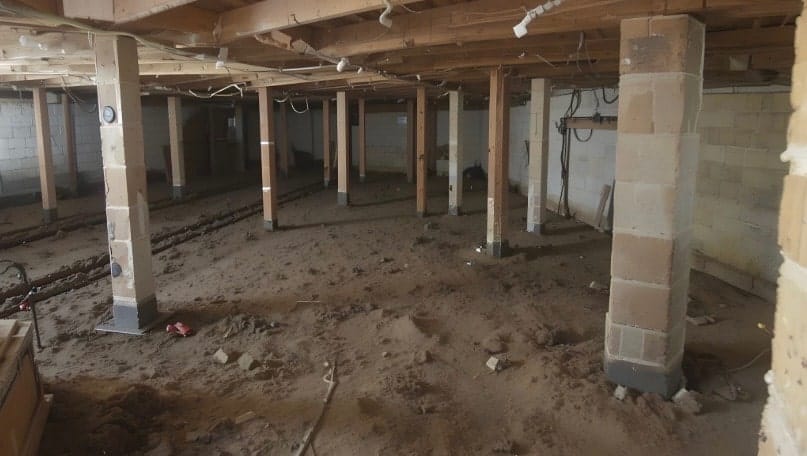
1. Preparation and Planning

Have a reputable, experienced contractor walk your site with you. They will assess both the inside and outside of your home
A contractor should:
- Assess the condition of your current foundation and supports
- Checking the height between the floor and ceiling of your basement or crawlspace
- Inspect the inside and outside grade for any drainage issues
This will save you from any surprises you may not be aware of.
2. Have A Radon Test Done
If you haven’t already, have your home tested for radon.
Radon is a radioactive gas that naturally releases from soil and stone. Some properties have higher levels than others. The only way to know is to test. If your property comes back with high levels, a radon mitigation system needs to be installed for your health.
Trusted resource for Radon Testing and Information In Massachusetts
https://www.mass.gov/info-details/testing-your-home-for-radon
3. How Does the Excavation Work?

Removing dirt in a confined basement can be tricky — that’s where our vacuum truck services come in. Instead of hauling soil out by hand or with heavy machinery that can’t fit access tight spaces, we use a vac truck to safely and efficiently remove excess dirt through hoses.
This keeps your home cleaner and minimizes disruption to your yard and structure. The hose on a vac truck can reach several hundred feet, which makes it a valuable asset sensitive tight spaces.
Read More about Vacuum Truck Services:
4. Prepare for a Safe, Level Slab
Here what to expect:
- Remove excess dirt & address any structural reinforcements that many be needed
- Install proper drainage mitigation system if needed
- Level and compact the subfloor to the proper depth
- Install proper drainage, such as gravel or sand
- Add a vapor barrier to prevent future moisture issues
- A thin foam gasket between the concrete and foundation can allow for some movement.
- Pour a new concrete slab to create a strong, dry foundation
- Seal any cracks in the foundation
- Proper ventilation, such as a fan or dehumidifier
Depending on your plans, we can also install necessary plumbing or electrical rough-ins before the slab goes in.
Pro Tip: If the foundations footings are shallow, a raised concrete floor may be necessary

5. Waterproofing & Insulation Matter

Basements are prone to moisture. We recommend adding interior or exterior waterproofing solutions to protect your new living space.
Insulating under and around the slab helps keep the space warm and energy-efficient. Each property will differ depending on needs & construction of the home.
6. Finish Your New Family Space
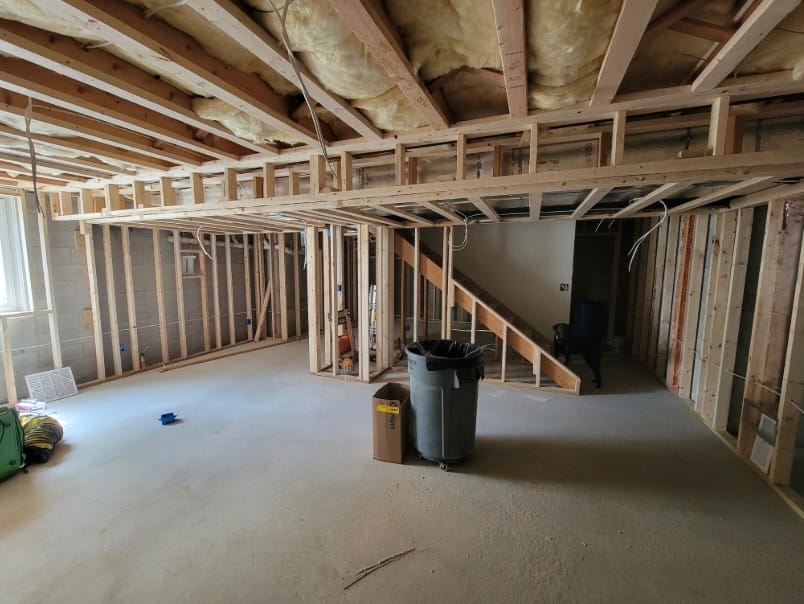
Once the concrete floor is in place, your basement is ready for framing, drywall, electrical, and all the finishes that make it a cozy, usable space — from built-ins to a home theater!
Why Work With Construction Solutions, Inc.?

Our team combines vacuum excavation, foundation work, site development, and residential construction expertise — so you get a contractor who knows how to handle tight spaces and older homes safely. We serve homeowners across Massachusetts, Southern NH, and Southern ME, bringing years of experience to every basement conversion.