

Table of contents
- The Importance of Daylighting
- What Is Utility Daylighting?
- Why Utility Daylighting Matters Before Mechanical Excavation
- Dig Safe Marks Are the Beginning of Safe Excavation Planning
- What Is the Difference Between Utility Locating and Utility Daylighting?
- How Vacuum Excavation Supports Utility Daylighting
- Hydro Excavation vs. Air Excavation for Utility Daylighting
- Vacuum Excavation Services In Massachusetts

The Importance of Daylighting
Underground utilities are one of the most significant challenges facing excavation contractors, utility companies, municipalities, and commercial construction teams. Before an excavator bucket enters the ground, project teams need to understand what is below the surface and where potential conflicts exist.
That is where utility daylighting becomes an essential part of modern excavation planning.
Utility daylighting uses controlled excavation methods to expose underground facilities so their location, depth, and orientation can be visually confirmed. In many situations, vacuum excavation provides a precise method for removing soil around buried utilities before mechanical excavation begins.
For construction projects throughout Massachusetts, utility daylighting can help contractors reduce uncertainty, improve planning, and work more safely around congested underground infrastructure.
At Construction Solutions, Inc., we provide vacuum excavation and utility exposure services for contractors, utility projects, municipalities, commercial properties, and construction teams throughout Massachusetts and the surrounding region.
What Is Utility Daylighting?
Utility daylighting is the process of carefully exposing an underground utility to visually confirm its location.
The process may be used to determine:
- The horizontal location of a utility
- The approximate depth of the facility
- The direction or alignment of the utility
- Potential conflicts with proposed construction
- Whether multiple underground facilities occupy the same area
Daylighting is often performed by excavating a carefully controlled test hole near a known or suspected underground utility.
Unlike conventional mechanical excavation, vacuum excavation removes soil through a suction system, allowing crews to expose utilities with greater precision in appropriate applications.
The information obtained during daylighting can then help project teams make better decisions before larger-scale excavation begins.

Why Utility Daylighting Matters Before Mechanical Excavation

Mechanical excavation is an essential part of construction and site development. However, operating excavation equipment near underground utilities requires careful planning and appropriate excavation methods.
A utility strike can create serious consequences, including:
- Worker and public safety hazards
- Damage to utility infrastructure
- Project delays
- Emergency repairs
- Service interruptions
- Increased construction costs
- Potential regulatory and liability issues
The challenge is that underground conditions are not always fully understood from plans, maps, or surface markings alone.
Over time, sites can change. Utilities may have been installed during different construction periods, infrastructure may be congested, and existing records may not provide all of the information needed for a specific excavation operation.
Utility daylighting helps reduce that uncertainty by allowing project teams to physically verify underground conditions before proceeding with mechanical excavation.
Dig Safe Marks Are the Beginning of Safe Excavation Planning
In Massachusetts, Dig Safe notification and utility marking requirements are an important part of excavation planning. The Commonwealth defines excavation broadly, including activities such as digging, drilling, trenching, grading, backfilling, and demolition. Excavators must also comply with applicable notification and excavation requirements before beginning work. (Massachusetts Government)
However, professional excavation planning does not end when markings appear on the ground.
Surface markings provide critical information about the presence and general location of underground facilities. But construction teams must still use appropriate precautions when working near those facilities.
Massachusetts guidance explains that excavation close to located utilities requires non-mechanical means and reasonable precautions. The Massachusetts Dig Safe law defines a safety zone around marked facilities and recognizes certain vacuum and air excavation methods as non-mechanical means designed to minimize direct contact with utilities. (Massachusetts Government)
For contractors and project managers, this makes utility daylighting an important consideration when planning excavation near underground infrastructure.

What Is the Difference Between Utility Locating and Utility Daylighting?
Utility locating and utility daylighting serve different, but have complementary purposes.

Utility Locating
Utility locating identifies the approximate location of underground facilities.
This may involve:
- Utility company markings
- Electromagnetic locating equipment
- Ground surface markings
- Private utility locating services
- Review of available utility records
Locating provides critical information before excavation begins.
However, not every underground facility may be owned or maintained by a participating utility, and some private utilities may require separate locating services. Dig Safe itself notes that participating utility companies are responsible for marking facilities they own or maintain, while private utility lines may require a private locator. (Massachusetts Government)
Utility Daylighting
Utility daylighting physically exposes the underground facility.
This allows crews to visually verify the utility’s actual position before proceeding with excavation in the area.
Together, locating and daylighting can help provide a more complete understanding of subsurface conditions.
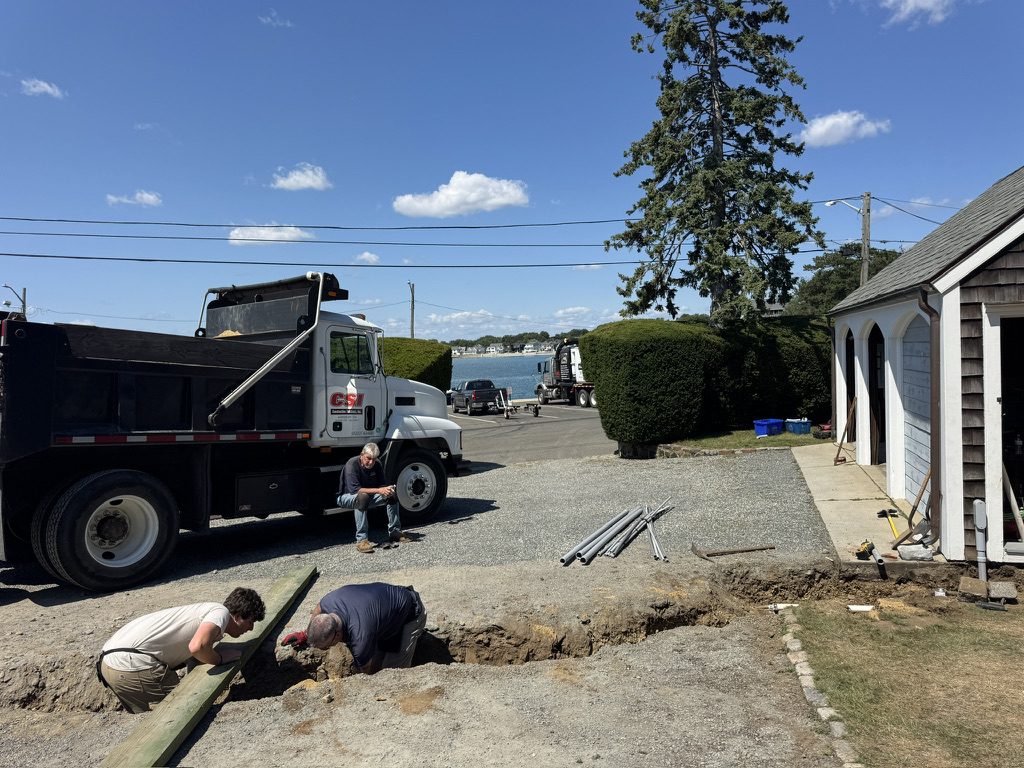
How Vacuum Excavation Supports Utility Daylighting
Vacuum excavation uses suction to remove soil from a targeted excavation area.
Depending on site conditions and project requirements, the soil may be loosened using water or compressed air before being removed through a vacuum system.
The material is then collected in the vacuum truck’s debris tank for transport and disposal or management as appropriate for the project.
For utility daylighting, vacuum excavation can provide several important advantages.
Precision Around Underground Utilities
Traditional excavation equipment is designed to move large volumes of earth efficiently. That makes it essential for many site development and construction operations.
However, when crews need to expose a specific underground facility, a more controlled excavation approach may be appropriate.
Vacuum excavation allows soil to be removed from a targeted area while helping crews work carefully around the facility being exposed.


Improved Visibility
Once the soil is removed, the utility can be visually identified.
Project teams may then be able to confirm information such as:
- Location
- Alignment
- Depth
- Clearance from proposed work
- Potential conflicts with other underground infrastructure
This information can be particularly valuable when planning trenching, utility installation, foundation work, or other excavation operations.
Reduced Reliance on Assumptions
Construction schedules often depend on accurate information.
When underground conditions are uncertain, assumptions can lead to unexpected conflicts after mechanical excavation has already begun.
Daylighting provides project teams with additional field information before moving into critical excavation areas.


Access in Congested Areas
Many Massachusetts construction sites contain dense underground infrastructure.
This is especially common in:
- Urban and downtown areas
- Older commercial developments
- Municipal rights-of-way
- Utility corridors
- Industrial facilities
- Renovation and redevelopment projects
Vacuum excavation can provide a practical solution for exposing utilities in areas where precision is particularly important.
Hydro Excavation vs. Air Excavation for Utility Daylighting
The best vacuum excavation method depends on the project, soil conditions, utility requirements, and site constraints.
Hydro Excavation
Hydro excavation uses pressurized water to loosen soil, which is then removed through the vacuum system.
Using Hydro excavation may be effective for many utility exposure and excavation applications, particularly where soil conditions require